Physical Address
17033 Neubrandenburg
Germany
Physical Address
17033 Neubrandenburg
Germany


15 honest answers to the questions everyone asks before embarking on this ancient path — without romanticizing, but with deep respect for tradition. Explore the path. Read the questions.

→In many traditional cultures — From Siberia to the peoples of the Andes — the shamanic calling is passed down through hereditary lines. The spirit chooses someone from the family, often after the death of the previous shaman. This so-called „"shamanic illness"“ or initiatory crisis is considered a sign of election.
But this is not the only possibility. In many traditions—especially in North America and Central Asia—the calling can also affect outsiders. What matters is not lineage, but inner experience: dreamlike visions, intense encounters with spirits, or a profound awakening experience.
In Western contexts, many practitioners work without any family lineage. The question is less about that. whether it is possible, but how honest how one deals with oneself and with tradition.
Passed down within the family across generations
Visionary experiences, crises, or spiritual awakening
Recognition and instruction by an experienced shaman
Shamanism is not a hobby—it is a calling that requires certain inner qualities. Not everyone is suited to this path, and that is not a judgment, but a sober observation.
The ability to perceive subtle levels of reality—in nature, in people, in dreams. Shamanism begins with listening.
The shaman works for others. Genuine compassion is essential — as is the ability not to lose oneself in the process.
Shamanic work confronts one with difficult energies and suffering. Stability of mind is not optional, but a fundamental requirement.
Anyone who thinks they know everything is already a stranger to shamanism. The path demands lifelong discipleship—to teachers, spirits, and nature.
Rituals, ceremonies, and practical techniques.
Initial healing work under supervision.
Dream work, meditation, connection with nature.
Independent practice and personal responsibility.
Shamanic training follows no fixed curriculum. It is deeply personal and often shaped by the teacher or the spirit world itself. Typically, it begins with years of inner work—interpreting dreams, observing nature, getting to know one's own shadow—before any ritual techniques are taught. Patience is not just a virtue on this path: it is the practice itself.
In traditional cultures, the initiation rite is not a formality—it is a death and a rebirth. The initiate undergoes a symbolic dissolution of the old self, often accompanied by physical trials, isolation, or intense visions.
In a Western context, there are modern equivalents: sweat lodge ceremonies, fasting rituals in nature (vision quests), and shamanic journeys accompanied by experienced masters. These rituals should never be performed alone or without qualified guidance.
Yes — in many traditions, one is not considered a fully-fledged shaman without initiation. The spirits themselves "initiate" the candidate.
Initiation can also happen spontaneously and without an external ritual — through profound life experiences or spiritual crises.
A formal ritual under expert guidance creates clarity, security, and anchoring in the process.
Online courses can be a valuable starting point — but no substitute for lived, embodied experience in direct contact with nature, community and a true teacher.
Traditional shamans are often healers, herbalists, and psychological advisors to their community. In their context, shamanic and medical knowledge were inextricably linked. In modern Europe, however, these roles are clearly separated.
A modern shaman in Germany must not be a doctor —but he should know his limits. Mental illnesses, addiction problems, or physical ailments belong in the hands of trained professionals. Shamanic work can accompanying They can have an effect, but never replace it.
However, basic knowledge of psychology and crisis intervention is recommended for every practitioner — especially when leading ceremonies or working in healing contexts.
This question touches upon one of the deepest contradictions of modern shamanism. Traditionally, shamans lived amidst nature, in close connection with animals, plants, and the elements. But the spirit world knows no city limits.
Even in large cities, there are places where nature speaks—if you learn to listen. An old tree in the city park can be a powerful teacher.
A consciously designed space in one's own home creates continuity for daily practice — regardless of where one lives.
Urban shamanic circles, drumming evenings, and ceremony groups are growing. In some ways, the community is replacing the connection to tribal culture.
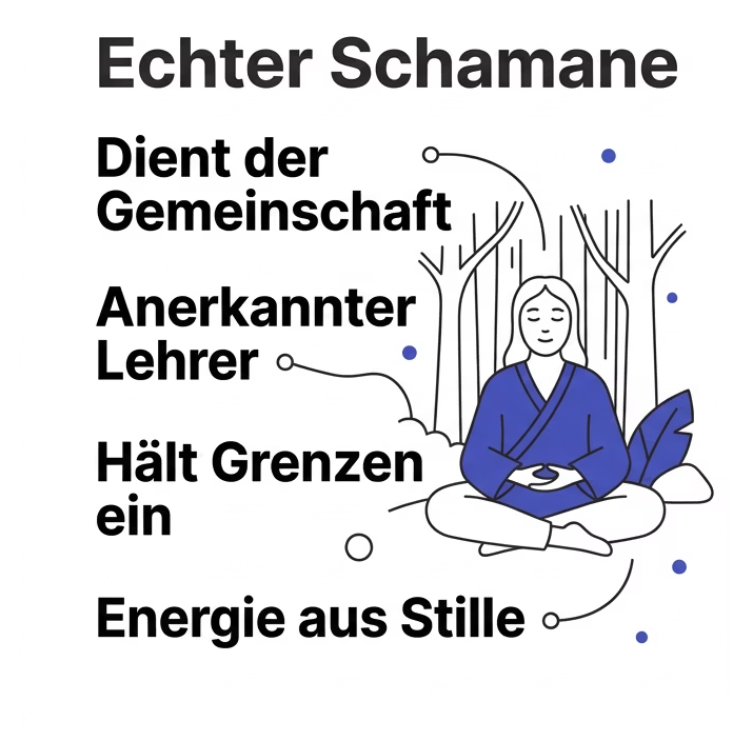

The most important thing is service: A true shaman places himself at the service of the community, not the other way around. Those who primarily seek power, admiration, or money have already strayed from the core of the path—regardless of how many ceremonies they have led.
Legal framework
In Germany, there is no explicit ban on shamanic practice. Spiritual guidance, ceremonies, and rituals are legally permitted within the framework of religious freedom. However, there are clear boundaries that every practitioner should be aware of.
Medical diagnoses or promises of treatment are prohibited by law for laypersons—this applies without exception to shamans as well. Anyone who makes promises of healing or carelessly guides psychologically vulnerable people through intense ritual states risks legal consequences.
Special caution is advised when using psychoactive substances: German narcotics laws apply without exception, even in a ritual context.
No promises of healing without medical approval
Psychoactive substances are subject to German law.
For paid services, business registration is required.
| Dreams and visions Recurring dreams involving animals, ancestors, or other worlds can be a sign — especially if they repeat themselves over years. | Sensitivity to nature An unusually deep connection to nature, the feeling of being "understood" by animals or plants. |
| Borderline experiences Intense experiences of transitions — birth, death, illness — often associated with a call to heal. | The test of time A genuine reputation doesn't fade after a few months of admiration. It remains, even if one tries to suppress it. |
This question doesn't deserve a quick answer. The shamanic path rarely reveals itself through a single experience—it unfolds through a series of signs that only become recognizable as patterns in retrospect.
Many of the most deeply skilled shamanic practitioners lead perfectly ordinary professional lives—as teachers, doctors, craftspeople, or artists. Shamanism was rarely a full-time profession in the modern sense in traditional societies. The ceremonies took place on the margins of everyday life, at dusk, at night, during the season of silence.
Economic independence also protects against one of the greatest dangers: the pressure to make a living from shamanic work. must. Those who are financially dependent on clients are easily tempted to overstep boundaries or fulfill expectations instead of serving the truth.
The shamanic path is not a wellness program. It demands the whole being — and can have serious consequences without proper preparation and guidance.
Intense rituals and altered states of consciousness can trigger psychotic episodes in individuals with pre-existing conditions. Prior psychological stability is a prerequisite.
Those who heal others without protecting and cleansing themselves risk permanently carrying the burdens of others — a classic burnout phenomenon in spiritual professions.
The feeling of being specially chosen can lead to arrogance and detachment from reality. The healthy counterpoint is always humility and grounding in everyday life.
Some teachers foster dependence instead of independence. A good teacher sets the student free—a good teacher doesn't bind them permanently.
„"The spirit does not ask about origin — but it does ask about respect."“
This is one of the most sensitive issues in modern shamanism. Many indigenous communities view the adoption of their sacred practices by outsiders—especially from Western countries—as cultural appropriation and a violation of their heritage.
At the same time, there are traditions that consciously open themselves up and view their knowledge as a gift to humanity. Ultimately, the decision rests with the respective community and the individual teacher.
What is undeniably true is that anyone who practices shamanic elements from a foreign culture bears the responsibility to do so with genuine historical knowledge, deep respect, and the explicit blessing of their teachers—and never as a backdrop for self-realization.
Name and honor the source of a practice, do not conceal it.
Learning only from teachers who deliberately invite outsiders
Pass on what you have learned for the benefit of others, not for self-promotion
Choosing a teacher is perhaps the most important decision on the shamanic path. A bad teacher can do more harm than no teacher at all.

In Siberian traditions, seven years of intensive training is considered the minimum. In other cultures, it is twelve years or more before someone can independently lead ceremonies. These timeframes are not arbitrary numbers—they reflect the depth of what must be learned and embodied.
In a Western context, this timeframe is often underestimated. Someone who practices as a shaman after a weekend workshop may have learned techniques—but has not yet acquired wisdom. The journey has no end. The best shamans describe themselves as learners even in old age.
A shamanic path that is "completed" after two years was probably not a shamanic path — but a course.
Further links: