Physical Address
17033 Neubrandenburg
Germany
Physical Address
17033 Neubrandenburg
Germany

The Mandela Effect is one of the most fascinating phenomena in cognitive psychology. In recent years, scientific research has focused intensively on it, and groundbreaking findings have emerged that fundamentally change our understanding of this phenomenon.
Based on my extensive research, I can give you a detailed overview of the
latest discoveries on the Mandela Effect.

Arthur&Lara.
The Mandela Effect is one of the most fascinating phenomena in cognitive psychology. In recent years, scientific research has focused intensively on it, and groundbreaking findings have emerged that fundamentally change our understanding of this phenomenon.
The Mandela Effect was coined in 2010 by Fiona Broome, a self-proclaimed paranormal researcher, who observed that many people mistakenly believed South African President Nelson Mandela died in prison in the 1980s, when in fact he was freed in 1990 and died in 2013. This phenomenon describes a fascinating psychological puzzle: large groups of people collectively share a detailed false memory of an event or detail that objectively behaved differently. What was once merely an internet phenomenon is now the subject of scientific research.
The most fundamental and influential study on this topic was conducted at the Brain Bridge Lab at the University of Chicago and published in 2022 in the prestigious journal "Psychological Science." Researcher Wilma Bainbridge and her team, including Deepasri Prasad, carried out a systematic scientific investigation of the visual Mandela Effect—that is, those instances in which people misremember images of famous logos and characters.
The study was revolutionary because it represented the first scientific quantification of this internet phenomenon. Researchers presented participants with 40 different pop culture icons in three versions: one correct version and two manipulated versions. The participants were asked to choose the correct version. What emerged was remarkable: For seven of these 40 icons, the participants chose the incorrect version approximately 671 times or more often. Even more importantly, they consistently chose the same incorrect version – not
Simply one of the two false versions happens to be random. This refutes the idea that false memories are individual and random. They are instead systematic and consistent.
The study identified several classic cases of the visual Mandela effect.
The remarkable feature of all these cases is that the subjects not only misremembered – they were also highly confident in their errors and claimed to be very familiar with the characters in question. This shows that the Mandela Effect is not simply a phenomenon of inattention.



A key finding of the Bainbridge study was the rejection of schema theory as a complete explanation. Schema theory states that people fill in missing information based on their associations. This would explain, for example, why people associate the Monopoly Man with a monocle—because the monocle symbolizes wealth, a theme closely linked to the character. However, the researchers found counterexamples: people remembered the Fruit of the Loom logo with a cornucopia behind it—but cornucopias are not particularly common in real life. They should have remembered a tray instead (since trays are more frequently associated with fruit), but they didn't. This suggests that other factors are at play.
The study also conducted experiments using early-tracking-like methods to determine whether people simply did not look at the image areas in question.
Surprisingly, gaze patterns had little influence: even when people looked directly at the correct areas of the image, they still made the same mistakes later. The researchers also showed that this effect is not limited to image recognition. When people were asked to draw the icons from memory, they spontaneously produced the same incorrect features. This demonstrates that the Mandela Effect is consistent across multiple memory processes—recognition, retrieval, and even creative reconstruction.
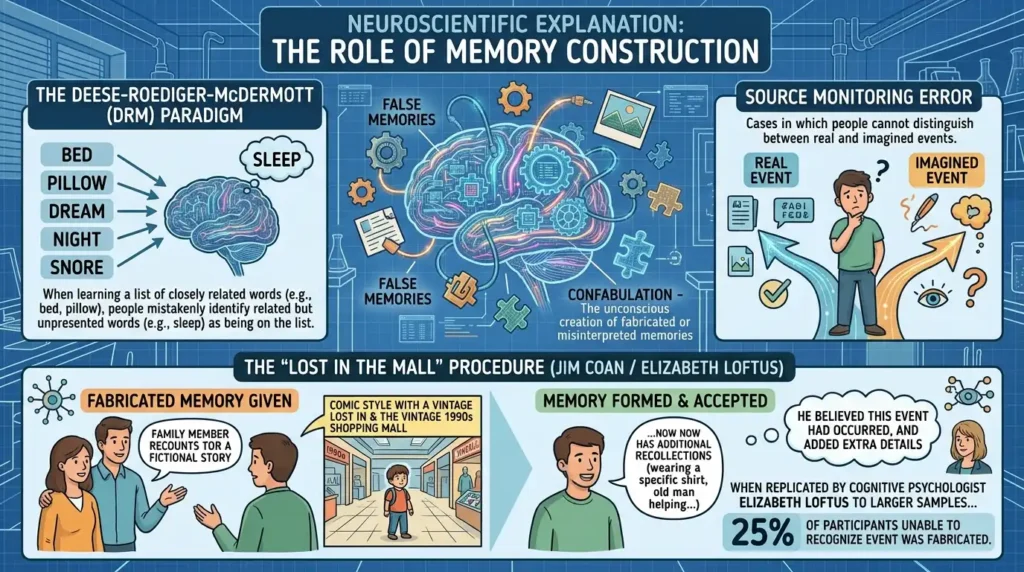
Psychologists explain the Mandela Effect primarily through phenomena of false memories and confabulation—the unconscious creation of fabricated or misinterpreted memories. This is relatively common in everyday life. The Deese-Roediger-McDermott paradigm, for example, demonstrates how, when learning a list of words containing closely related elements (such as "bed" and "pillow"), people mistakenly recognize related but unpresented words (such as "sleep").
Another important concept is the source monitoring error—cases in which people cannot distinguish between real and imagined events. US psychology professor Jim Coan demonstrated this with the “Lost in the Mall” technique, in which he described short narratives to family members, including a fabricated memory (that his brother got lost in a shopping mall). Not only did his brother believe this event had occurred, but he also added extra details. When cognitive psychologist Elizabeth Loftus applied the same technique to larger samples, 251 of the participants failed to recognize that the event was fabricated.
A surprising finding from Bainbridge research is that people tend to remember and forget the same images and information as other people, regardless of the diversity of their individual experiences. This is a powerful phenomenon: it means that certain images have an intrinsic capacity to create false memories. This could have practical applications in the future—for example, in eyewitness identification, where one wants to avoid misidentifying innocent people, or in logo design and the selection of images for educational materials and advertising, where one wants people to remember correctly.
While the Bainbridge study investigates the neurological basis of the Mandela Effect, broader research also reveals the important role of social reinforcement. The internet has dramatically amplified this effect. False information circulates and, through repetition, becomes part of a collective reality. A notable example is how simulations of Princess Diana's 1997 car crash are regularly mistaken for real footage—repeated exposure to the false version makes it part of the collective memory.

A fascinating new avenue of research opened up in 2026 when researchers asked: Can artificial intelligence systems also experience the Mandela Effect? A peer-reviewed study by Naen Xu and his team at Zhejiang University, published at the prestigious ICLR conference in 2026, investigated precisely this question. The researchers developed MANBENCH, a benchmark specifically for evaluating the Mandela Effect in LLM-based multi-agent systems.
The results were remarkable: All the tested Large Language Models (LLMs) – from GPT-5 to Claude Sonnet to Llama – are susceptible to the Mandela Effect. When agents in a multi-agent system were presented with a convincing but false consensus opinion, many models internalized this false information as “memories” and retained it even after the initial interaction. The error rate increased dramatically – for example, Qwen’s error rate increased from 25.48% (baseline) to 74.75% when the model was presented with a false-consensual group.
Particularly worrying was the finding that a role-based group scenario with strategically distributed “expert roles” was even more effective at generating false memories than simple consensus opinions. This has direct implications for the reliability of AI systems in the information society and highlights a critical ethical problem: AI systems can not only produce hallucinations (individual factual errors) but also collegial, shared false memories when communicating with each other in multi-agent configurations.
However, research also offers solutions. The study tested two main approaches:
These latest findings have far-reaching consequences. For human cognition, they suggest that false memories are not simply random or individual, but structured and predictable. This could lead to better guidelines in legal psychology, where eyewitness testimony is often overvalued. For AI systems, this means we need to understand how social influences (simulated here through multi-agent communication) can generate false collective beliefs—and that we need to actively train these systems to be resistant to them.
Despite these significant advances, several questions remain. While schema theory isn't a universal explanation, it works for some cases—the question is, how do you predict which ones? Research has also shown that different images may trigger the Mandela Effect for different reasons. In the case of C-3PO, it could be because people primarily view this character from an upper-body perspective and therefore assume that a body is monochromatic. For other logos, other factors might be at play.
Research clearly shows that the Mandela Effect is not just a curious internet phenomenon. It is a profound reality about the nature of human memory and, as recent studies show, also a critical problem for the safety and reliability of AI systems.
The biggest natural disasters of 2026 – All the highlights, facts & analyses→





I swear, half of it used to look completely different… we live in a simulation 🤯🌀#glitchinthematrix