Physical Address
17033 Neubrandenburg
Germany
Physical Address
17033 Neubrandenburg
Germany

The genetic map of medieval Europe
What we know as medieval history is a staged facade. Beneath the surface of familiar place names, religious rituals, and seemingly harmless legends lies the logbook of one of the most ambitious genetic experiments in human history. This documentary traces the footsteps of a forgotten civilization that used Europe as a testing ground—and whose legacy still slumbers in our maps, our language, and our myths.
Confidential
Alternative Research
Crypto-etymology
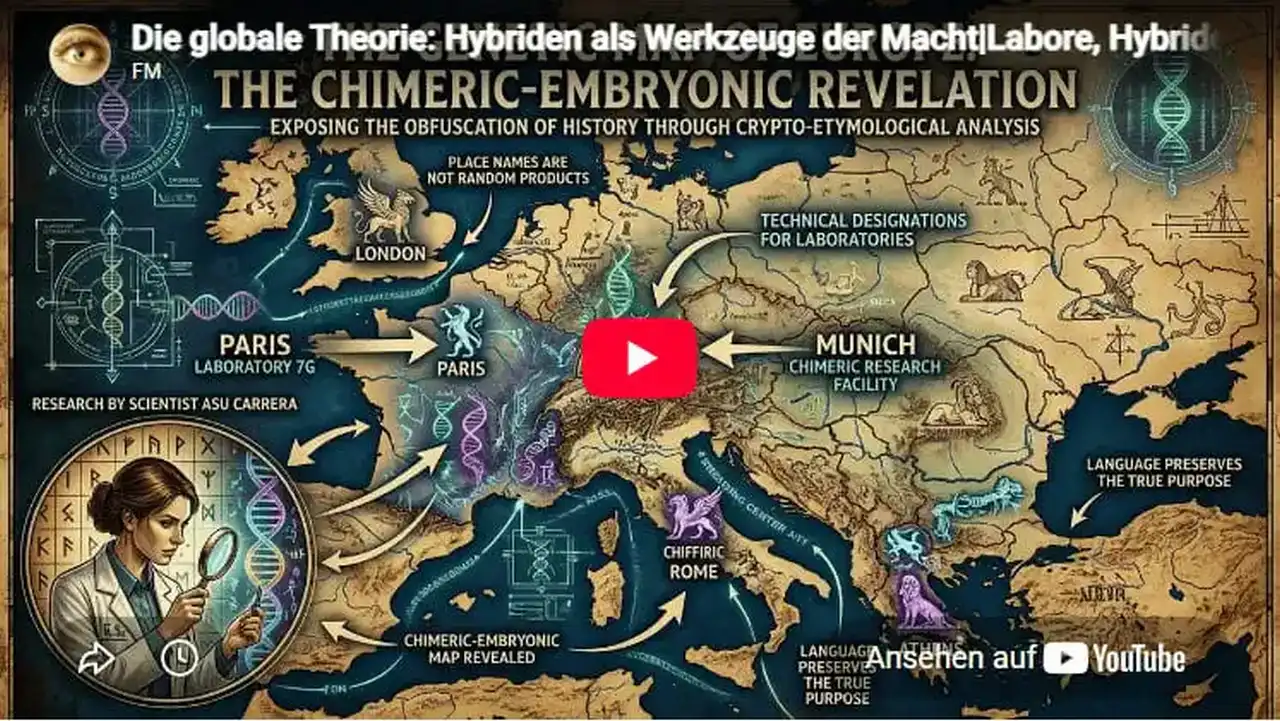
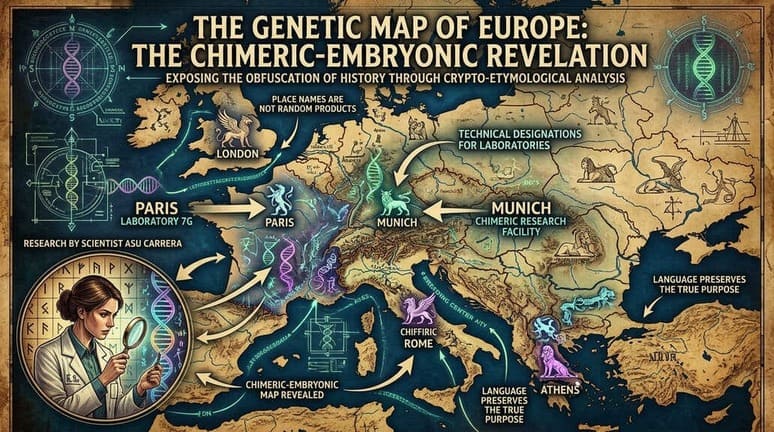
The topography of Europe, particularly that of Portugal, is not the result of organic settlement history. It is the hidden logbook of an unprecedented genetic experiment. The researcher Asu Carrera Through her crypto-etymological analyses, she has uncovered a „chimeric-embryonic map“ that proves that place names are not random products, but technical designations for a comprehensive network of laboratories and breeding centers.
We are dealing here with the material remains of a technologically advanced civilization that used the Middle Ages as a testing ground for creating artificial life forms. Modern historiography has systematically obscured this reality—but language does not lie. Place names are fossilized labels that preserve the true purpose of their locations, even when official history rewrites them.
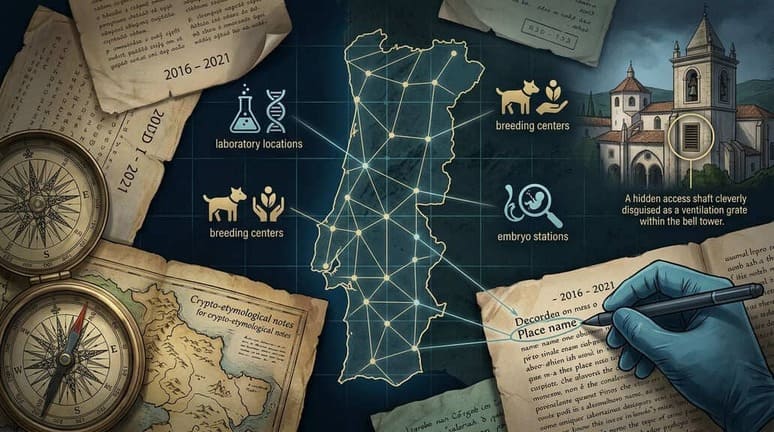
Place names are not cultural accidents, but technical designations for laboratory sites, breeding centers and embryonic stations of a coordinated network.
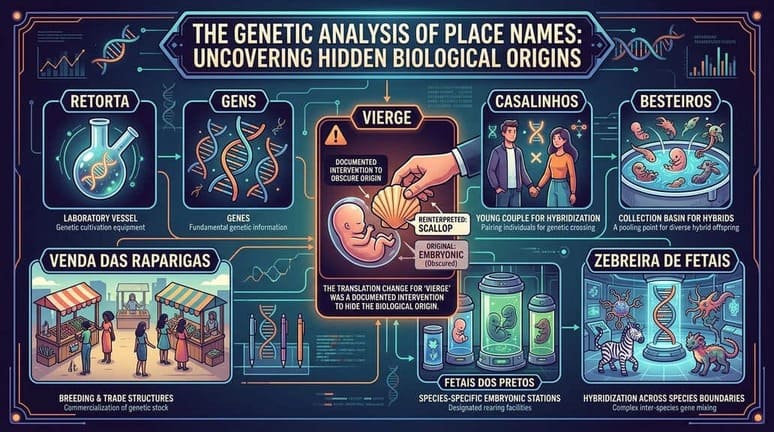
Crypto-etymological analysis of historical translation databases, especially the significant changes between 2016 and 2021, which demonstrate active obfuscation.
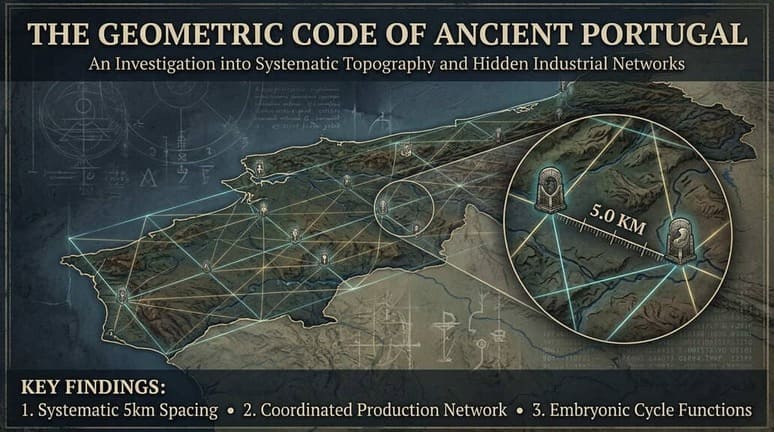
Systematic five-kilometer grid of Portuguese towns, documented translation manipulations and architectural anomalies in monastery complexes.
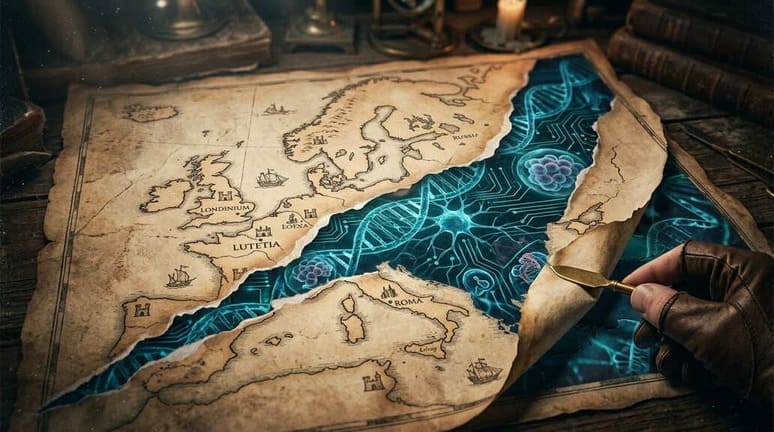
An examination of Portuguese topography reveals a disturbing pattern. Many locations lie within a precise five-kilometer radius of one another—a distance that appears to have been a necessary technical condition for the biological processes of the time. This geometric precision is no accident: it reflects the logistical architecture of a coordinated production network, in which each station fulfilled a specific function in the embryonic cycle. Furthermore, the systematic manipulation of translation databases—particularly the significant changes between 2016 and 2021—suggests an active obfuscation of this legacy. Terms that once carried unambiguous biological meanings have been retrospectively redefined to obscure their original reference.
| Place / Concept | Genetic interpretation | Conspicuousness |
| Retorta | Laboratory vessel (retort) for biological processes | Direct laboratory reference in the place name |
| Genes | Direct reference to genes | Biological technical term as a place name |
| Casalinhos | „Young pair“ or „breeding pair“ for hybridization | Breeding concept encoded in place names |
| Besteiros | Bestiary or zoo; collection point for hybrids | Collection of living experiments |
| Vierge | Historically (2016) translated as "embryonic"; today changed to "comb" or "scallop". | Suspicious translation change |
| Venda das Raparigas | „Sale of girls“ — reference to breeding and trafficking structures | Commercial dimension of the network |
| Fetais dos Pretos / Carneiros | Embryos from black sheep | Species-specific embryonic stations |
| Zebreira de Fetais | Zebra embryos | Hybridization across species boundaries |
The translation change of „Vierge“ from „embryonic“ to „scallop“ between 2016 and 2021 is the smoking gun: a documented intervention in historical databases that is intended to actively obscure the biological origin of the term.
The connection is particularly revealing in Odivelas. The monastery there is the origin of the famous sweet treat. Barriga de Freira — „Nun’s belly“. In an investigative context, this is not a harmless name, but a cultural artifact that points to the physical reality of swollen bellies and mass pregnancies in these „laboratory monasteries“.
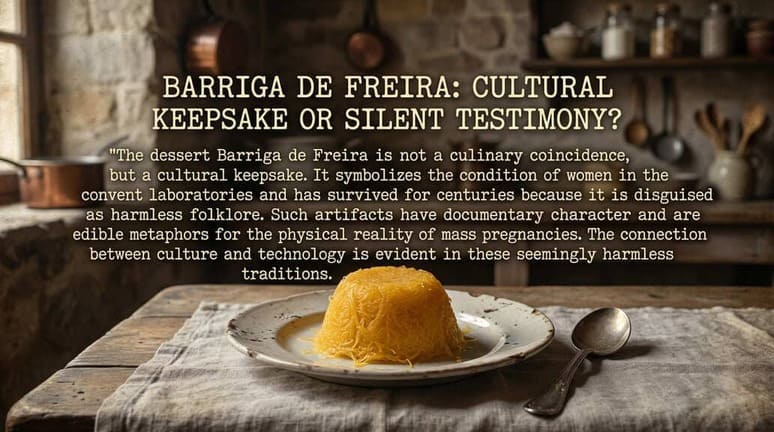
The spatial arrangement is revealing: Odivelas is located in the immediate vicinity of the Infantado — literally „Department for Infants.“ These two sites, together with the women’s convent, form a triangulated system covering all phases of the embryonic cycle: from conception through pregnancy to rearing. The literal translation of Odivelas — „Go and see them“ — sounds less like a place name and more like an instruction for inspectors of a breeding program.
The dessert itself, a pastry with a puffy, round shape, is no culinary accident. According to the logic of crypto-etymological analysis, it is a cultural memento—an edible metaphor for the condition of women in these institutions. Such artifacts survive for centuries because they are disguised as harmless folklore, while at their core they possess a documentary character.
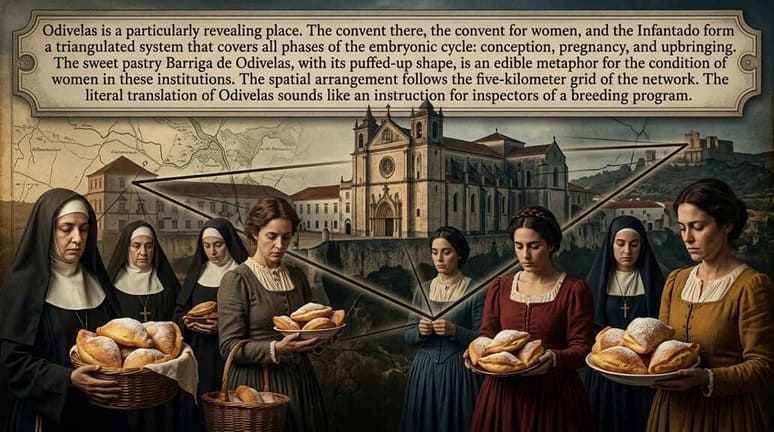
The distance between these locations follows the five-kilometer grid of the overarching network.
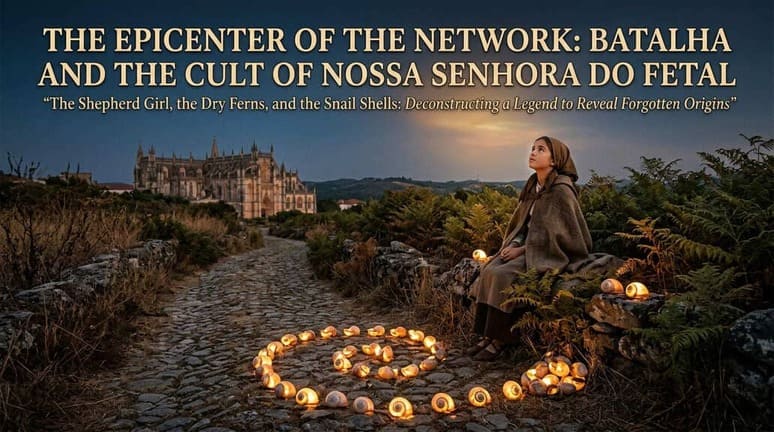
The epicenter of the entire network is located at Batalha, where the cult of "Nossa Senhora do Fetal" — Our Lady of the Embryo — is practiced. The official legend of the church tells of a shepherdess girl who, during an extreme drought, saw the Virgin Mary amidst ferns (Fetal) appeared. Scientifically, this is impossible: ferns are moisture-loving plants and do not grow in bone-dry soil. This botanical inconsistency is not a trivial detail—it is an indication that the legend was constructed later to explain a place whose original function had long been forgotten.
A shepherdess sees the Virgin Mary in a drought-stricken area amidst ferns. Botanically impossible—ferns require moisture. The legend is a later obfuscation.
The term "fetal" undoubtedly refers to the embryo. The fact that a second place with the same name exists exactly 120 kilometers to the north is proven by a standardized, networked system.
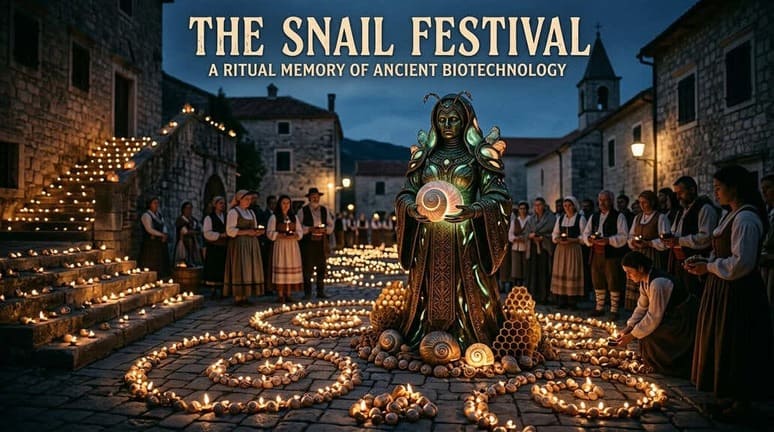
At the annual festival, thousands of snail shells are lit as oil lamps. The snail symbolizes the uterus and the technological process of embryonic development.
The "Borrowed Mother of Embryos" functions in this system as a kind of biological queen bee or swarm mother, responsible for the mass production of life. This figure connects Slavic and Iberian traditions in a way that can only be explained by a supra-regional, coordinated network. The snail festival is not a folkloric curiosity—it is a ritual memory of a technological process clothed in religious symbolism to endure for centuries.
The work, published in 1642, by Ulisse Aldrovandi In conventional scientific history, it is considered a collection of curiosities—a book of fables and figments of the imagination. This assessment is fundamentally wrong. Aldrovandi, widely recognized as the father of modern natural history, explicitly emphasized that all illustrations were made "from nature"—that is, from real-life models. He was not a fantasist, but a systematic observer who documented what he saw, regardless of whether it fit the worldview of his time.
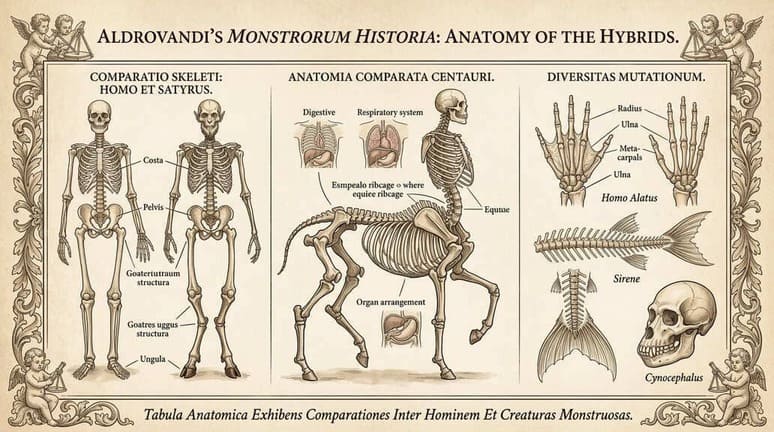
The work contains detailed comparisons between human skeletons and the skeletons of hybrids. Aldrovandi compares bone structures, joint positions, and organ arrangements with the precision of an anatomist—not a storyteller.
Beings like satyrs, fish-men, bird-men, or centaurs were created through trial and error. They were organic prototypes or clones in which genes were randomly combined or deactivated to test their viability.
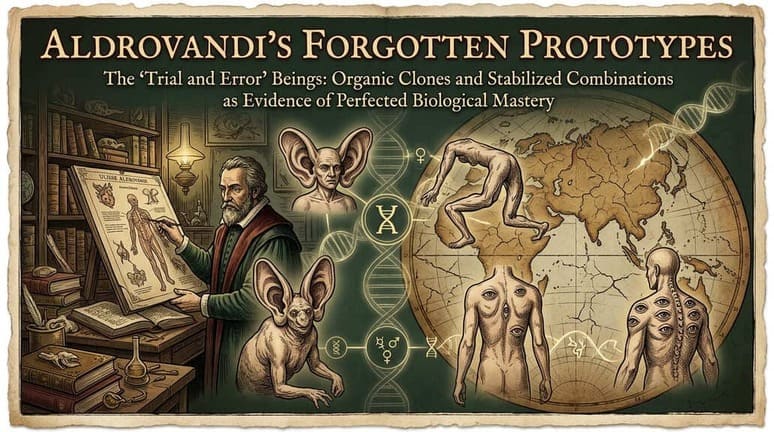
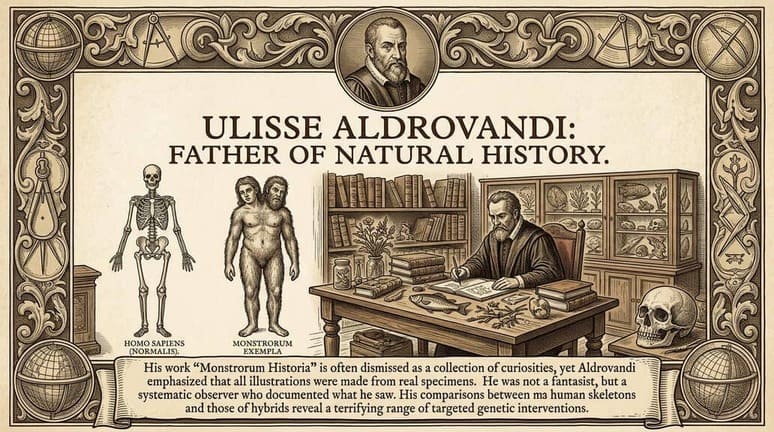
Documented are creatures with giant ears, reversed limbs, no heads (with eyes on their backs), or hybrid creatures of humans and horses — a frightening range of targeted genetic interventions.
The conclusion is inescapable: "Monstrorum Historia" is not a catalog of fantasy, but a scientific report on the results of an ongoing experimental program. Aldrovandi documented what he saw—and what he saw were the remains and living specimens of a biotechnology far exceeding our current understanding. The question is not whether these beings existed, but why we today act as if they never were.
The creation of these beings was part of a global strategy by a technologically superior civilization to replace Earth's original population with specialized slaves or "worker humans." This thesis, radical as it sounds, is supported by parallel accounts from entirely different cultural spheres—accounts that are strikingly similar in their core features.
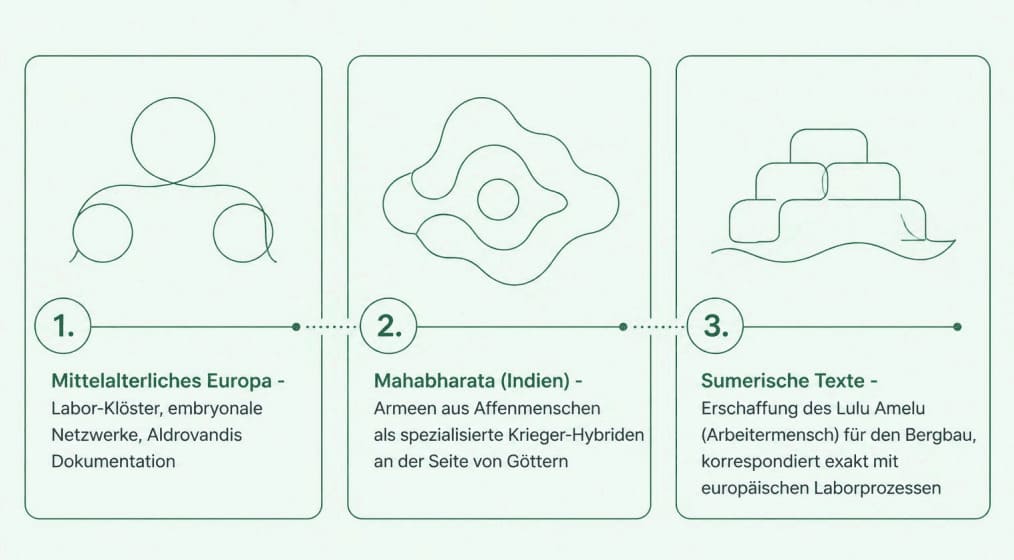
Modern historiography employs an "extended chronology" to shift these events—which actually took place in the 18th and 19th centuries—into a distant, mythical "antiquity" or a dark "Middle Ages." This temporal displacement is not an academic error but a strategic operation: by placing the events in an indeterminate past, they are stripped of any political urgency and transformed into harmless myths. The Mahabharata describes armies of ape-men fighting alongside "gods"—in reality, specialized warrior hybrids. The Sumerian texts depict the creation of the Lulu Amelu, The description of the working man, for mining—a description that corresponds exactly to medieval laboratory processes in Europe. These correspondences across continents and millennia are no coincidence. They are the fingerprints of a single, globally operating civilization.
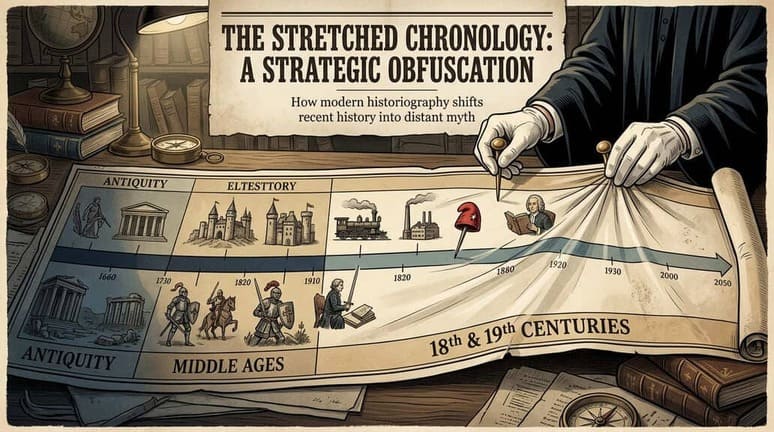
The „stretched chronology“ is the central instrument of obfuscation: events of the 18th/19th centuries are shifted into mythical antiquity in order to disguise their technological nature.
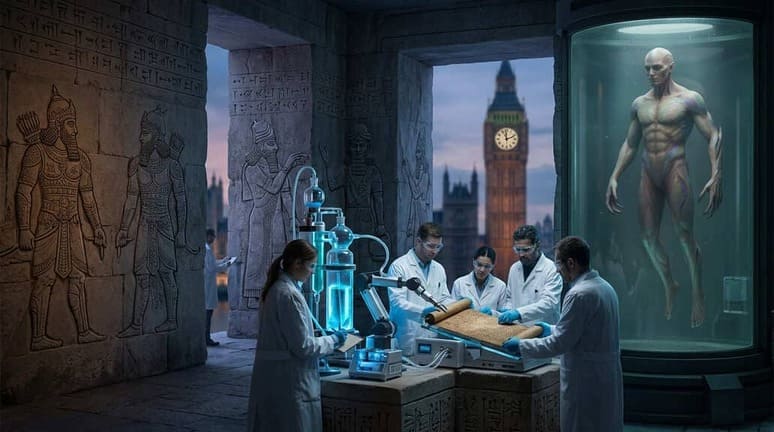
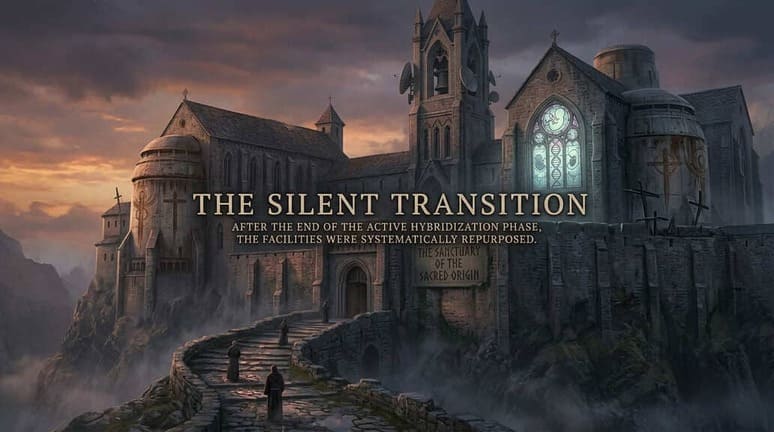
After the active hybridization phase ended, the facilities were systematically repurposed. The religious disguise served to sacralize their technological origins and keep the population unaware of the sites' true function. Monasteries offered the perfect facade: secluded, authoritarian, with their own legal system and absolute discretion.
The breeding centers in Odivelas became places of pilgrimage. The embryonic stations became shrines. The laboratory buildings became chapels. Every function was reshaped into a sacred form—but never completely erased.
→Sacralization: Technical terms were overlaid with religious symbolism (e.g., "Fetal" → "Fern")
→Translation manipulation: Historical databases were actively altered (Vierge: „embryonic“ → „scallop“)
→Folklorization: Real processes were degraded to harmless customs and festivals (snail festival)
→Chronological shift: Events of the 18th/19th centuries were transposed into mythical antiquity.
The repurposing of these sites was not a spontaneous act, but a coordinated process that spanned generations. Religious orders took over the infrastructure, adapted the architecture, and developed new narratives that completely obscured the original purpose. Yet traces remained—consciously or unconsciously. The sweets, the festivals, the place names: all these are cultural sediments that cannot be entirely erased. Those who understand the language of obfuscation can read the underlying reality like a palimpsest.
Aldrovandi's documentation proves that genetics at that time was far more advanced than our current level. The ability to stably combine skeletal structures and organ functions across species boundaries—albeit through reckless experimentation—testifies to consummate biological mastery. This finding turns our entire understanding of the history of science on its head.
The „Monstrorum Historia“ was published at a time when official scientific history knew nothing of such biotechnology.
Precise spacing between laboratory locations — a technical necessity for the network's biological processes.
Exact distance between the two "fetal" locations — proof of a standardized, networked system.
Documented period in which historical terms were actively reinterpreted to obscure biological references.
The documented diversity of mutations—from creatures with giant ears to reversed limbs to headless beings with eyes on their backs—shows that the experimenters were not merely manipulating individual genes, but redesigning entire body plans. Stabilizing such combinations across species requires an understanding of developmental biology that modern science is only beginning to grasp. Aldrovandi was not a collector of curiosities. He was the chronicler of a lost science.
This documentary follows a trail that leads from the etymological surface into the depths of a hidden history. Every answer raises new questions—and that is precisely the point. History as we know it is a palimpsest: overwritten, but not erased. Those who ask the right questions can read the original script.
The density of laboratory sites in Portugal is exceptional. Was the country a primary testing ground, or was its geographical location—on the western edge of Europe, with access to the Atlantic—strategic for the transport and distribution of the hybrids?
The coordination across hundreds of kilometers, the standardized distances, and the uniform terminology point to a central authority. Which institution—religious, state, or secret—had the power to operate such a network for generations?
Aldrovandi documented them. Sumerian texts describe their deployment. The Mahabharata recounts their armies. But where did they go? Were they systematically destroyed when the experiment ended? Or do their genetic traces live on in today's population?
The documented translation changes between 2016 and 2021 show that obfuscation is not a historical phenomenon, but an active, ongoing process. What did research during this period uncover that necessitated a response?
„"Language does not lie — but it remains silent if one does not know how to question it. Every place name is a question waiting for an answer."“
Further research
Open questions
Stay vigilant
Another unsolved mystery →The forgotten chronicle of the apocalypse