Physical Address
17033 Neubrandenburg
Germany
Physical Address
17033 Neubrandenburg
Germany


There are more magic books than ever before. There are online courses. There are groups. There are gurus who claim to have all the answers.
And many people are confused.
They read Wicca. Then they read Hermeticism. Then Shamanism. Then Eastern magic. They buy courses from five different teachers, all of whom contradict each other.
After a year, they are more confused than at the beginning.
That's the problem: there's too much information. Too many traditions. Too many opinions.
In this article, I'll show you how to navigate this chaos. How to distinguish good sources from bad ones. And how to build a genuine path – not one imposed from the outside, but one that works for you.„"A realistic view
on learning"“
The internet is wonderful and terrible at the same time.
Wonderful: You can access millions of resources for free.
Terrible: Most of it is nonsense.
Someone can go online and say "I am a magic expert" and thousands of people will follow them – without that person ever having any real practice.
That's a big problem.

Test 1: Does the author have real experience?
Don't look at how many followers the person has. Look at how long they have been practicing.
„I have been practicing for 20 years“ is better than „I have 100,000 followers“.
True practitioners are humble. They don't say, "I am a master." They say, "I have been practicing for many years and I am still learning."„
Test 2: Do they contradict reality?
If someone says, "If you do this ritual, your crush will love you in a week," ignore them.
That's a lie. It doesn't work. Anyone who says that has no real experience.
Real practitioners say: "Magic works through inner change. It takes time. It is not guaranteed."„
Test 3: Will they sell you something you don't need?
Many "teachers" earn money by telling you that you need expensive items.
„"You need these crystals ($200). You need these candles ($100). You need my course ($500)."“
Real teachers say: "You need almost nothing. You only need yourself."„
If someone wants to take your money for items, be skeptical.
Test 4: Are they dogmatic?
If someone says, "This is the ONLY way to practice magic" – beware.
True magic has many paths. There is no "single" way.
Someone who is dogmatic has not truly understood what magic is.
Test 5: Can they explain?
A real teacher can explain why something works. Not mystically. But understandably.
When someone surrounds something with mystery – „It’s too deep a secret to explain“ – that’s probably nonsense.
Real teachers can explain complex things simply.

Classic books (reviewed):
Not all classic books are good, but these are tried and tested classics with genuine knowledge.
Modern practical books:
Online resources:
What you should avoid:
Not because they are perfect. But because they have been tested.
If a book is 50 years old and is still being read, it probably contains genuine knowledge.
A blog post written the day before yesterday might be nonsense.
Start with the classics. Then expand.
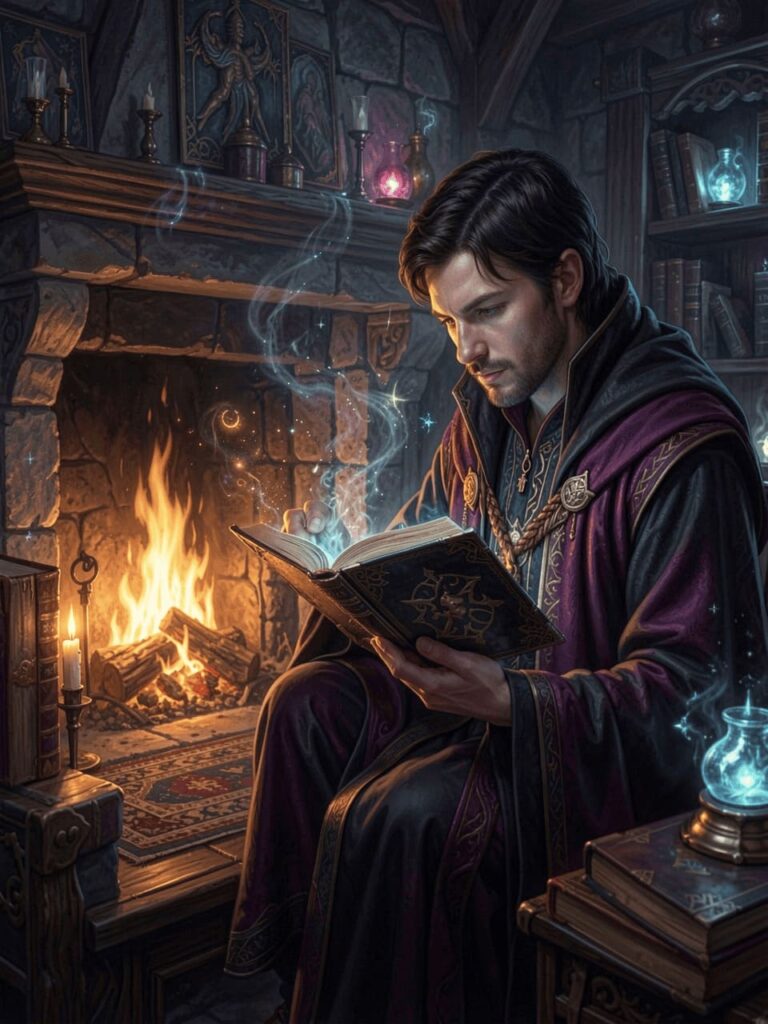
Some people can learn on their own. Others need a mentor.
It depends on your personality.
You develop your own path
If you don't have a mentor, you will make mistakes. But those mistakes are yours. You learn from them.
A mentor could impose their path on you. Learning alone, you'll find your own.
You will become more critical
Without an "expert" telling you everything, you will learn to think for yourself.
That is valuable.
It's free (mostly)
You don't need money for a mentor.
You can be manipulated.
Without an experienced mentor, you can fall into bad resources.
A mentor could warn you against doing something foolish.
You make more mistakes
Not all mistakes are valuable. Some are simply a waste of time.
A mentor could warn you against unnecessary detours.
You can get stuck.
If you have a problem and there's no one to ask, you could get stuck.
You learn faster
A good mentor can guide you directly. You'll avoid many mistakes.
You will receive personal guidance.
A mentor sees you. He knows where you're stuck. He helps you overcome it.
You have access to hidden information.
Some things aren't written in books. A true mentor knows these.
You develop his path, not yours.
A mentor shows you his path. That might not be your path.
It can be expensive
Real mentors earn money. That can cost a lot.
You are addicted
If your mentor is unavailable, you're stuck.

Do not search online
The best mentors aren't online. They're in your local community.
Search for groups, clubs, and workshops in your area.
Trust your instincts
If someone feels wrong, they probably are wrong.
If someone feels right, they might be the right one.
Ask for recommendations
Talk to other practitioners. Ask: "Who would you recommend?"„
Observe before you commit.
Before you "follow" a mentor, observe him.
How does he speak? How does he treat others? Is he modest or arrogant?
I have a trial interview
Please arrange an initial meeting – free or paid.
Feel if the chemistry is right.
The best approach is probably to learn alone, but with some mentor contacts.
This is what it could look like:
This gives you the advantages of both: independence and guidance.
That's the biggest problem: there are hundreds of traditions.
Wicca. Hermeticism. Shamanism. Taoism. Buddhism. Hoodoo. Brujería. Italian folklore. Slavic traditions.
They all work. They all have genuine knowledge.
But you can't learn them all at once. You'll lose yourself.
This is the most important rule: Choose ONE path and practice it seriously for at least one year.
Not multiple paths. One path.
Why? Because magic doesn't work in a way that allows you to mix all techniques.
It's like music: if you play jazz, classical, and heavy metal all at the same time, it becomes nonsense.
But if you truly learn a style, you will become a master.

Test 1: What speaks to your heart?
Not what is "best". But: What feels right to you?
If you are attracted to nature, choose nature magic or shamanism.
If symbols and mystery attract you, choose Hermeticism or Tarot.
If faith and spirituality attract you, choose religious magic.
Test 2: What is available near you?
If there is a Wiccan coven in your city, and no shamanism teacher, choose Wicca.
Community availability is important.
Test 3: What can you combine with your life?
If you are very busy, choose a tradition that doesn't take much time.
If you have time, choose one that is more intense.
Step 1: Learn the basics (3 months)
Read the classic books of this tradition. Understand the philosophy.
Step 2: Practice of basic techniques (6 months)
Practice the basic practices of this tradition regularly.
Not everything. The basics.
Step 3: Evaluation (after 1 year)
After one year: Does this approach work for you?
Yes: Delve deeper.
No: Change to a different path.
That's okay. After a year of serious practice, you can switch.
But: Don't change because it's difficult. Change because this path isn't right for you.
The difference is this: difficulty is part of learning. But if a path fundamentally doesn't suit you, that's different.
After several years of serious practice in ONE tradition, you can integrate others.
But not before.
A beginner who tries to mix five traditions will get lost.
An experienced practitioner can consciously integrate several traditions.
That's the difference.
What you do:
Not: Don't do any intensive practice yet. Just explore.
What you do:
Not: Doubt your choice. Give the path a chance.
What you do:
Not: Don't try to do everything at once. Focus on the basics.
What you do:
Many people fall in love with a teacher and follow him blindly.
„"My teacher says X, therefore X is true."“
This is not learning. This is worship.
Rule 1: A mentor is not infallible.
Your mentor is human. Your mentor can be wrong.
Listen to your mentor, but also think for yourself.
Rule 2: Not all teachers are good.
A teacher with many students is not automatically good.
Trust your instincts.
Rule 3: Learn from many, but practice one way
You can learn from many teachers. But your main practice should be consistent.
Rule 4: Be ready to go
If a teacher tries to manipulate or control you, walk away.
A good teacher wants your independence, not your dependence.
| tradition | focus | Time required | difficulty | Best for |
|---|---|---|---|---|
| Wicca | Nature, rituals, gods | Medium | beginner | connection with nature |
| Hermeticism | Symbols, philosophy, consciousness | High | Intermediate/Advanced | intellectual |
| Shamanism | Travel, spirits, healing | High | mediator | Spiritual seekers |
| Tarot | Symbols, intuition, reading | Medium | beginner | Intuitive |
| Magic of the hands | Practical magic, everyday life | Low | beginner | pragmatist |
| Order Magic | Structure, degree, initiation | Very high | Advanced | Disciplinary |
| Natural Magic | Plants, herbs, soil | Medium | Beginner/Intermediate | nature lovers |
| Energy work | Subtlety, Chakras, Aura | Medium | beginner | Sensitive |
A: No, it's not wrong. It's normal. But: Focus on one subject for intensive practice. Study others in the background. After 1-2 years, you can integrate more.
A: Both are fine. Books are often better structured. Online is free. Ideally: Combine both.
A: Red flags: They want a lot of money. They say that only they know the truth. They want you to distrust others. They are not open to questions.
A: That's normal. Practice isn't easy. But: If it feels fundamentally wrong (not difficult, but wrong), it might not be your path.
A: Yes, but it's harder. Use online resources. Join groups. Find other learners.
A: At least 6-12 months. Then: If you learn, great. If not, walk away.
A: The internet is great for information. But personal relationships are better for transformation. Ideally: Combine both.
A: You can learn and practice online. Or you can occasionally travel to group sessions/workshops. Or you can find an online mentor.

Here is the central truth:
There is no "right" way to learn.
But some methods work better than others.
A good learning path has these characteristics:
With these principles you will not be lost.
The chaos of traditions, teachers, and books becomes a garden where you can find your own way.
Not the path others want for you.
Your path.
This is true education in magic.
This article was written for people who want to understand that the best learning is the learning you create yourself – with guidance, but not dependence.
Further links: