Physical Address
17033 Neubrandenburg
Germany
Physical Address
17033 Neubrandenburg
Germany

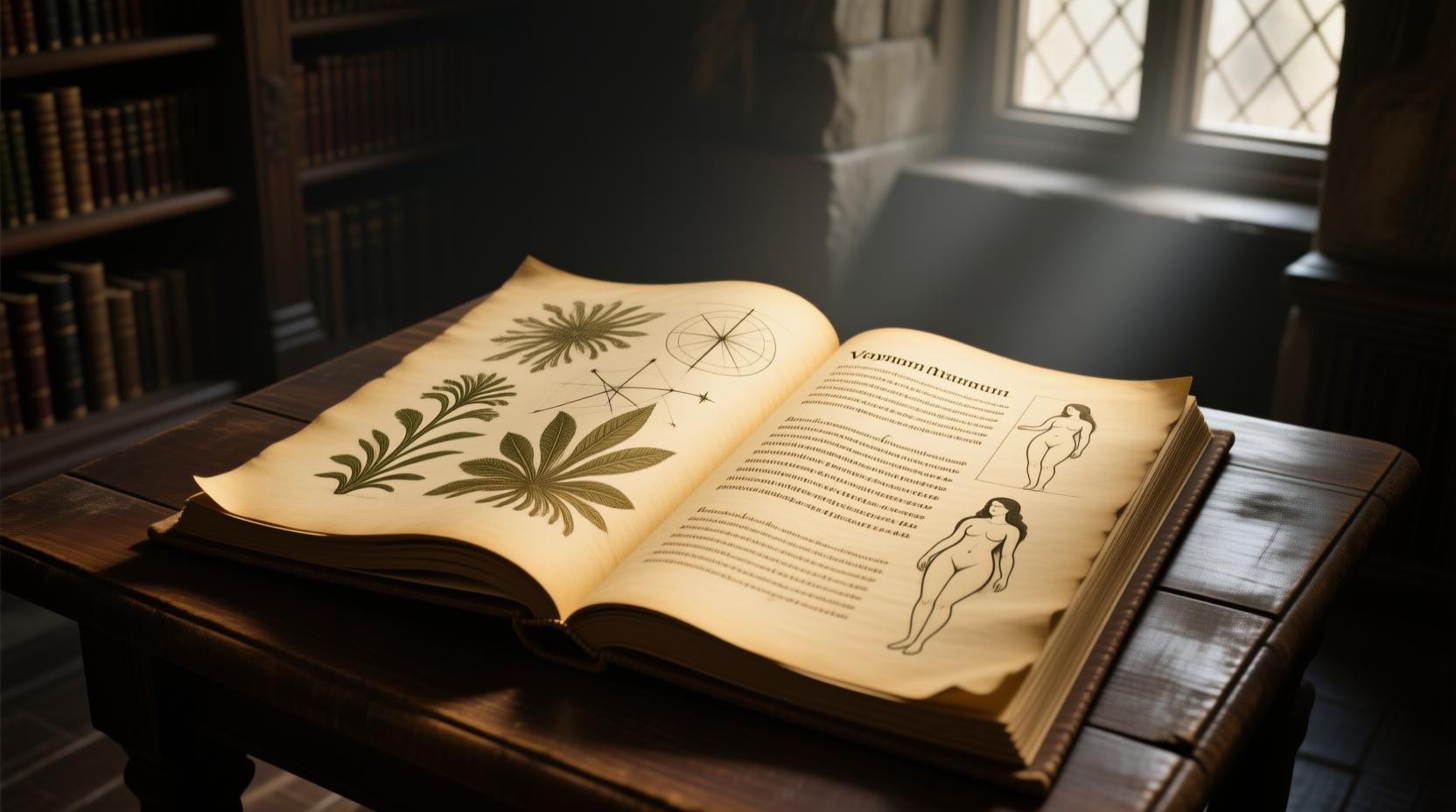
Imagine a book that has existed for over 600 years, is beautifully illustrated – and that no one has been able to decipher to this day. It is the Holy Grail of cryptography and one of the greatest bibliographical curiosities in the world: The Voynich Manuscript.
This thin, unassuming parchment book, named after the Polish bookseller Wilfrid Voynich, who rediscovered it in 1912, is no ordinary historical document. It is a time capsule full of impossible plants, strange constellations, and texts in a language that seems not to exist on our Earth.
The Voynich Manuscript is dated to the period between [dates omitted] using radiocarbon dating. 1404 and 1438 It is dated. It therefore originates from the early Renaissance. However, while the ink and parchment are clearly old, the content remains a mystery.
The manuscript, now housed in the Beinecke Rare Book and Manuscript Library at Yale University, is divided into several thematic sections. Each section is more disturbing than the last.
The most extensive part of the manuscript consists of detailed drawings of plants. At first glance, one might think it was a medieval herbal. But the problem is: None of these plants exist in our known flora.
The drawings are accurate, but the botanical characteristics contradict every known species. Some illustrations appear to combine random parts of different plants (leaves of one species, roots of another), while others are completely beyond our comprehension. What purpose did these descriptions serve? Were they remedies for diseases we don't know about, or simply the product of a botanist's imagination?
This section contains fold-out pages and complex circular diagrams that suggest astronomical or astrological content. We see depictions of stars, planets, and zodiac signs, but these do not correspond to the astronomical models of the 15th century.
The complex star charts could be an attempt to represent the universe in a way that is now forgotten – or they are simply the product of a foreign science.
Perhaps the strangest section of the book is the so-called "Balneological" or "Biological" part. Here you will find illustrations of complicated pipe systems, pools, and baths used by countless small, naked women be populated.
The women appear like nymphs navigating the strange, flowing structures. Cryptographers speculate that this part of the manuscript represents a kind of pharmaceutical manual, a bathing register, or instructions for ritual purifications. However, the context of the illustrations remains bizarre.
The centerpiece of the Voynich Manuscript is its unbreakable script. The text is written entirely in an unknown language or cipher, which cryptographers call a „Voynichese“ describe.
Although the manuscript has been studied for centuries by the brightest minds – including experts from the American and British intelligence services – it remains undeciphered to this day.
The inability to read the text has led to three dominant theories:
| theory | Description |
|---|---|
| 1. The complex cipher | The text is a genuine encrypted message, but it uses an extremely rare or multi-stage encryption method (e.g., a polyalphabetic code or even letter separation in the style of steganography). |
| 2. A forgotten language | Voynichese is indeed a natural language written down in an invented or rare alphabet. Supporters of this theory suggest an East Asian or Caucasian origin. |
| 3. The Ingenious Hoax | The manuscript is pure nonsense – a brilliant hoax, created to make money or to play a joke at the expense of scientists. Critics consider this theory unlikely, since creating a purely random, but statistically significant, sample is highly improbable. Consistent The text would represent an enormous effort for a joke. |
Despite modern computing power and linguistic algorithms, the Voynich Manuscript remains steadfast. Although there have been repeated sensational reports of alleged breakthroughs (often in connection with AI analysis), none of these solutions have been confirmed by the scientific community.
The Voynich Manuscript is more than just an unreadable book. It is a window into humanity's fascination with the unknown. Whether it is the writings of an eccentric medieval alchemist, medical secrets, or simply an artful deception, it poses the fundamental question: What if there are secrets that are meant to remain hidden in the past forever?
Until the next sensation, the manuscript remains the most beautiful, most enigmatic book in the world. It lies at Yale, patiently waiting for someone to find the right language to bring its silent pages to life.
→How mathematician Ivan Panin „proved“ the divine origin of the Bible“