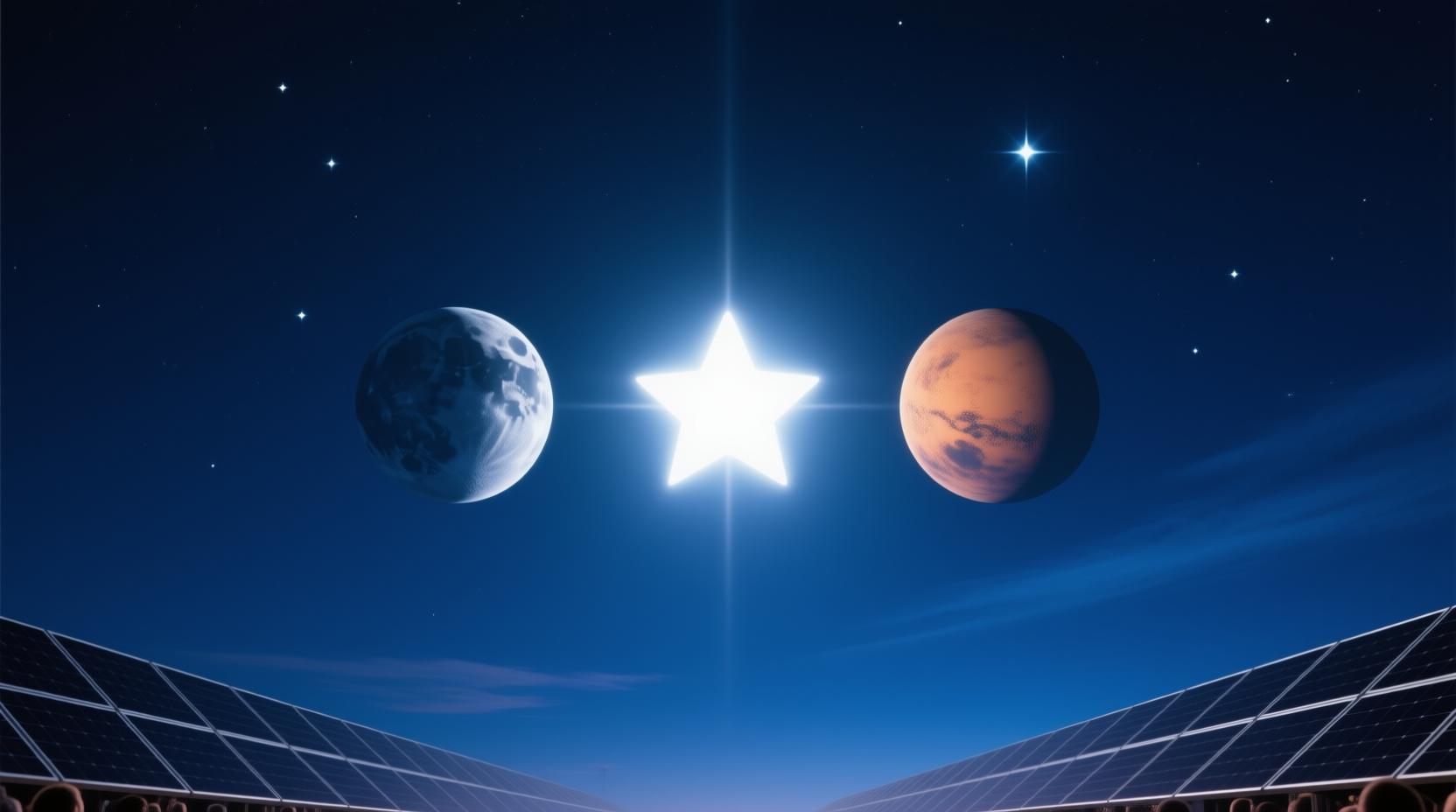
A solar parade of planets

Mercury, Venus and Mars merge to form the "Star of Bethlehem"„

A celestial spectacle awaits us: Mercury, Venus and Mars merge to form the "Star of Bethlehem"„

Attention all stargazers! In the coming weeks, an astronomical spectacle awaits us, reminding us of the festive season. Leading up to Christmas, a spectacular planetary parade will form in the evening sky, with the inner planets Mercury, Venus, and Mars coming so close that they could appear almost as a single, bright star to the naked eye – a "Star of Bethlehem" for our time.

For several weeks now, we have been able to admire Venus as a brilliant evening star on the western horizon. But now other celestial bodies are joining this spectacle. Mercury, Often difficult to spot due to its proximity to the sun, it will gradually brighten and move closer to Venus. Shortly afterward, it will also Mars to the constellation, which will give the whole thing a reddish tint.

What makes this conjunction so special?

A planetary conjunction, the apparent meeting of several planets in the sky, is a fascinating phenomenon in itself. But the upcoming conjunction is remarkable for several reasons:

  • Close approach: The planets will appear so close together in the sky that many observers will hardly be able to distinguish them as individual objects. This inevitably evokes images of the biblical "Star of Bethlehem," which led the Magi from the East to the birthplace of Jesus. Even if the scientific interpretation of the biblical star is disputed, the emotional and symbolic power of such a celestial phenomenon is undeniable.
  • Visibility of the inner planets: Both Mercury and Venus are often difficult to observe. Mercury, the innermost planet, is usually hidden in the sun's glare due to its proximity. Venus, although brighter, is also often only visible shortly after sunset or before sunrise. The fact that all three planets now appear simultaneously and in such a striking configuration in the evening sky is a rare opportunity.
  • The „red planet“ is also involved: The addition of reddish Mars lends the parades an extra dimension. Its presence could make the overall spectacle even more impressive and further reinforce the memory of the biblical star.

When and how can we observe the spectacle?

The best time for observation is in the coming weeks, especially as Christmas approaches, be. The planets will be after sunset at western horizon show.

A few tips for observation:

  • Look for a clear view of the horizon: Since the planets will be low in the sky, a clear view to the west is essential.
  • Patience is required: Mercury can be difficult to find at first. Take your time and scan the area just above the horizon.
  • A clear night is crucial: Clouds are the worst enemy of any skywatcher. Check the weather forecast.
  • Binoculars or a telescope can help: Although the planets may appear as a single star to the naked eye, binoculars or a small telescope allow the individual planets and their relative proximity to each other to be seen in even greater detail.
More than just an astronomical event

This celestial event is far more than just a physical arrangement of heavenly bodies. It awakens in us awe, curiosity, and perhaps even a sense of connection with those who gazed at the night sky thousands of years ago. The opportunity to witness something so closely resembling the prophecies and narratives of one of humanity's most significant stories is a wonderful chance to pause and marvel at the vastness of the universe.

So, pack your warm clothes, find a dark spot away from the distracting city lights, and look west after sunset. A very special "Star of Bethlehem" awaits you – a heavenly gift that brings us closer to the magic of the cosmos. Don't miss this fascinating natural spectacle!

Leave a Reply

Your email address will not be published. Required fields are marked *