Physical Address
17033 Neubrandenburg
Germany
Physical Address
17033 Neubrandenburg
Germany

First read "The Teaching of the Ten Sefirot".→
We all know those moments when an idea strikes us like lightning. A moment of pure insight, an "Aha!" that briefly rearranges the entire world. That is raw wisdom.ChokmahBut how often do these brilliant flashes of inspiration go to waste because we can't capture, organize, or apply them?
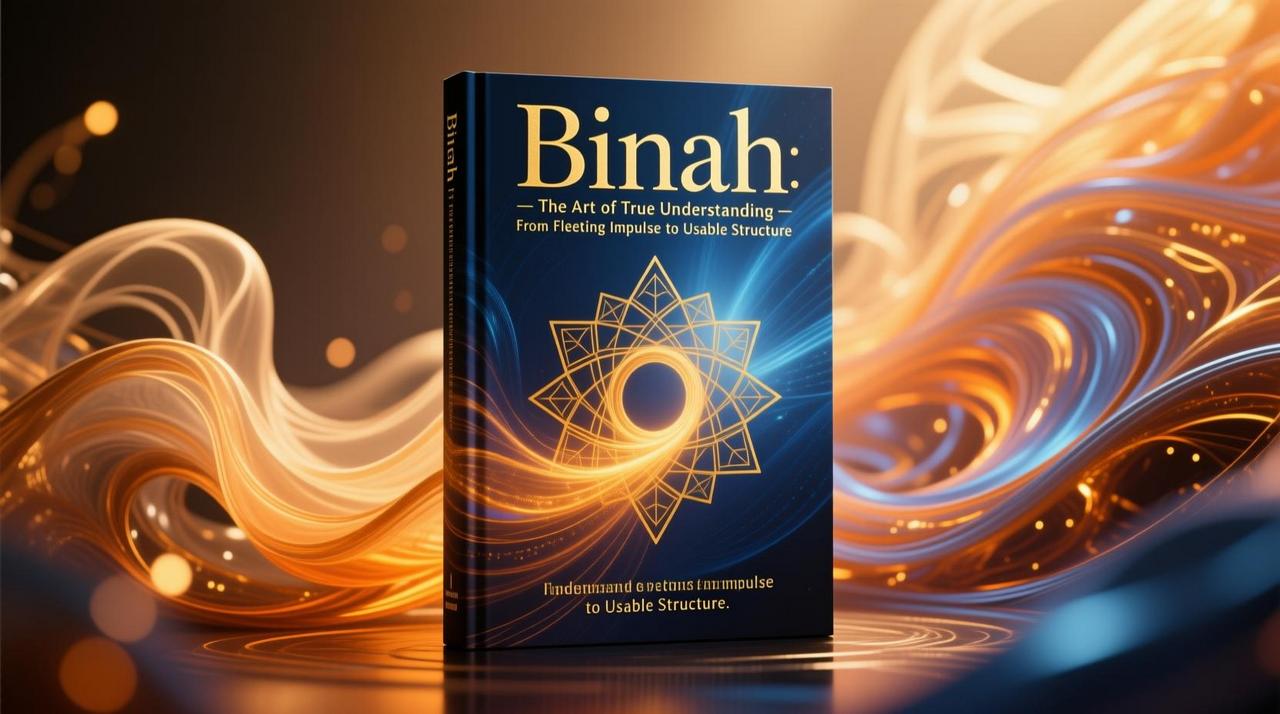
Here we encounter a key concept from spiritual psychology and Kabbalah that teaches us how to develop deep, usable understanding from fleeting perceptions: Binah, often translated as "understanding" or "intelligence".
Binah is not merely a passive reservoir of knowledge, but an active ability that makes the difference between mere knowledge and deeply rooted insight.
When raw, boundless wisdom (ChokmahWhen energy flows into our consciousness, it is initially formless, unlimited, and without structure. Binah serves as the container that sets a limit to this energy, processes it, and pours it into a manageable form.
Binah is the transition from unity to duality, from endless possibility to a defined concept.
The point is not to generate new ideas (that is Chokmah's job), but to thoroughly examine the ideas received, to recognize their implications and to understand how they work and where their limits lie.
The process of Receiving and reacting is central:
Those who master Binah are not merely collectors of facts, but architects of knowledge.
Binah manifests itself in our thinking through three fundamental processes that transform a vague "I understand" into a solid "I know how to apply this".
Shaping is Binah's primary function. Imagine Chokmah provides you with a huge block of marble (the raw idea). Binah is the chisel that works this block, giving it definition and revealing the contours of the concept.
In everyday life: When you need to solve a complex problem, shaping the information involves structuring the chaos. You create lists, diagrams, mind maps, or write a coherent report. Without this shaping, the idea remains a vague sense of possibility.
Binah shapes: It transforms the infinite energy of possibility (pure wisdom) into finite, tangible reality (understanding).
Knowledge without distinction is dangerous. Discernment is the ability to recognize the boundaries of a concept. What belongs and what does not? What is the cause, what is the effect? What is true, and what is merely noise?
Binah introduces the necessary duality to enable definitions. One can only understand light if one knows darkness; one can only define success if one knows what failure is.
In everyday life: The distinction is ours critical thinking. It is the ability to apply healthy skepticism, to examine arguments, to find flaws in logic, and to recognize when a concept doesn't work in a particular context. Only through discernment can we ensure that the knowledge we acquire is truly sound.
Once an idea has been formulated and distinguished from all unnecessary elements, it can be applied. Extension is the use of this structured understanding to expand it beyond its original context.
The goal is to generalize a principle that has been learned once:
This expansion brings our understanding to life and shapes our entire horizon, not just the narrow area in which the original wisdom was received.
Binah is not a mystical power available only to a select few; it is a trainable mental discipline. Here are ways you can strengthen your Binah:
Don't just read to consume information. Read to dissect. After each section, ask yourself how the author's arguments work. structured are (shaping). Which counterarguments were consciously addressed? omitted (Distinguishing)? How can you put this idea into a completely apply to other areas of life (Extension)?
Writing is the ultimate exercise in shaping ideas. When you have to put a complex thought into clear, understandable sentences, you force your mind to push the boundaries (discrimination) to define the concept. Journaling or keeping a structured learning diary are excellent Binah tools.
When you receive new information (e.g., in a conversation or lecture), listen actively and try to summarize the main point in your own words. formulate and they to the speaker to return. This not only confirms receipt but also forces your brain to give its own structure to the formless input.
Wisdom (Chokmah) is a divine gift, a spontaneous spark. But understanding (Binah) is the art of nurturing this spark, structuring it and integrating it into our lives so that it brings about lasting change.
Binah teaches us that it is not enough to have an idea. We need to know what it looks like, how it works, and how we can multiply it – through shaping, differentiation, and expansion.
Use Binah to exchange the passive collection of information for the active creation of insight. Only then does knowledge become true understanding.
Read the next of the ten Sefirot:-Chessed: The radiating power that expands and gives – A mirror of God's boundless love